

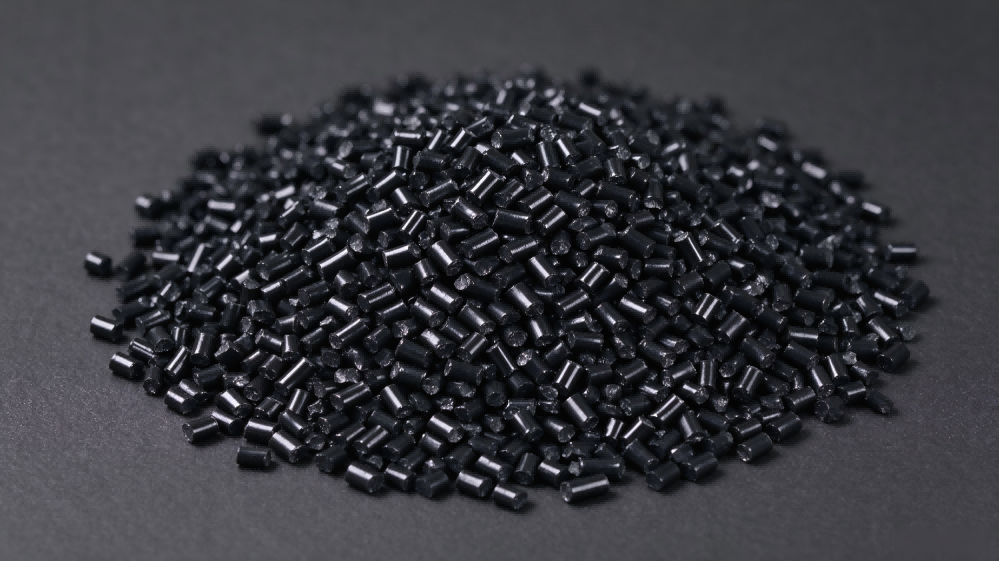
October 2026, Shanghai—When you point a TV remote at the device and press a button, an infrared signal travels silently through a dark-colored window, triggering a response from a set-top box several meters away. For over a decade, the material used for this window has been a quiet yet steady niche within the modified plastics industry: infrared-transmissive (IR-transmissive) black PMMA, PC, or ABS. The principle is straightforward: the material absorbs enough visible light to maintain a deep, uniform appearance, while allowing a high degree of transmission for near-infrared wavelengths—typically 850nm or 940nm.
By 2026, however, the downstream landscape for this category is being rapidly redrawn.
At CHINAPLAS 2026, which concluded in April, SABIC unveiled a comprehensive suite of material solutions for humanoid robots, spanning sensing, propulsion, enclosures, structural frameworks, and actuators. Notably, the company’s LEXAN™ IR-transmissive polycarbonate was highlighted for use in visual sensors, serving to "ensure precise environmental perception." Around the same time, Covestro emphasized that its own range of materials—combining optical clarity with high infrared transmission—enables accurate sensing and perception for vision and LiDAR systems. Meanwhile, LG Chem debuted a collection of innovative materials for humanoid robots, featuring IR-transmissive solutions designed for sensor housings and LiDAR, aimed at enhancing the reliability of distance and object detection.
The messaging from these three global industry giants points to a clear conclusion: IR-transmissive PC and PMMA are no longer merely "functional windows" on consumer electronics; they are evolving into an "optical skin" for robotic perception systems.
The numerical drivers behind this shift are quite direct. The global market for infrared-transmissive plastics is valued at approximately $633 million in 2025. Research institutions project a compound annual growth rate (CAGR) of 7.6% to 8.8% for the 2026–2032 period, with the market size expected to reach between $1.1 billion and $1.2 billion by around 2032. Optical windows for automotive LiDAR represent an even steeper growth trajectory: global sales are estimated at $780 million in 2025 and are projected to rise to $874 million in 2026, with a CAGR of 11.5% from 2026 to 2032. Industry analysis indicates that as the deployment of advanced autonomous driving systems accelerates, the installation volume of LiDAR units is entering a phase of exponential growth. Consequently, the infrared transmission performance and cost-effectiveness of radome (sensor cover) materials have become focal points of competition within the supply chain. In terms of technical approaches, plastic-based solutions—leveraging advantages such as lightweighting, the ability to form complex curved surfaces, and modular integration—are increasingly diverging from glass-based alternatives.
The competition regarding material performance has also reached a higher level of technical granularity. Taking PMMA-based materials as an example, specialized black, infrared-transmissive grades—modified for selective absorption—can achieve over 90% transmittance in the 600–950 nm infrared range (reaching approximately 91% at 850 nm and 93% at 900 nm), while keeping visible light transmittance below 5%. Meanwhile, polycarbonate (PC) solutions excel in LiDAR window applications: they can achieve over 90% transmittance for 800 nm laser beams while effectively filtering out interfering light near the 900 nm wavelength. Furthermore, these materials maintain sub-millimeter thermal expansion stability even during "cold starts" at temperatures as low as -40°C. For components like robotic face shields—which serve the dual purpose of providing structural protection and acting as an optical window—infrared-transmissive polycarbonate (PC) must maintain an infrared (IR) transmission rate of over 90% within the 600–950 nm wavelength range, while leveraging the impact resistance of the polycarbonate substrate to withstand knocks and friction during operation.
However, the term "infrared-transmissive" hardly captures the complexity involved in material selection. A technical analysis that gained widespread circulation within the industry in 2026 points out that black, IR-transmissive materials are essentially absorptive filters: dyes or pigments strongly absorb visible light while creating a transmission window for the target near-infrared wavelengths. In this context, material thickness is an integral part of the optical design; both the visible-light cutoff threshold and the transmission rate at the target wavelength shift in tandem with changes in wall thickness. Consequently, a single figure—such as "92% light transmission"—is virtually meaningless for colored, IR-transmissive grades. What is actually required is a spectral transmission curve that covers both the operating and cutoff wavelength bands. Furthermore, the fact that a material might perform well at 850 nm but not at 940 nm implies that the substrate selection and formulation design for LiDAR windows versus consumer electronic sensor windows may follow entirely different development paths.
Regulatory variables are also reshaping formulation strategies. The push to restrict PFAS (per- and polyfluoroalkyl substances) is forcing the optical plastics supply chain to re-evaluate hard-coating technologies and flame-retardant systems. By 2026, patents had already emerged for PFAS-free hard-coating resin compositions, aimed at replacing fluorine-containing alternatives without compromising appearance or optical performance. For PC-based IR-transmissive materials, balancing flame retardancy with the elimination of PFAS is particularly delicate, as these materials often serve both optical and structural safety functions in applications like robotic housings and IR windows. In May 2026, SPECTARIS, the German industry association for the photonics and optical technologies sector, issued a public warning that proposed PFAS restrictions could have profound implications for photonics, medical technology, and analytical instrumentation—adding a layer of regulatory urgency to the evolution of formulations for IR-transmissive optical plastics. Turning to the demand side, the pace at which humanoid robots reach mass production represents both the greatest uncertainty and the most significant source of potential. Industry observers have dubbed 2026 the "eve of mass production" for humanoid robots. Material suppliers have already prepared comprehensive solutions—covering everything from internal frameworks to "skin"—with a recurring emphasis on the need for high infrared (IR) transmittance in sensor housings. Covestro describes the current phase as "crossing the threshold into mass production," noting that materials for sensor windows must simultaneously deliver optical performance, high IR transparency, and physical protection to "ensure distortion-free sensing." While the unit cost of an IR sensor window may seem negligible, the scale effect for material suppliers becomes substantial when multiplied across millions of robots, each equipped with several—or even over a dozen—sensors.
The challenges are equally clear. The reliability standards required for automotive-grade LiDAR windows remain stringent, regardless of the weight advantages offered by plastic alternatives. In real-world operational environments, robots face abrasion, chemical exposure, and temperature cycling—conditions that demand far greater spectral stability from IR-transmissive black plastics than what is required for, say, a remote-control window. Furthermore, while absorption-based plastic solutions offer cost benefits and the potential for integrated injection molding, they must still be carefully distinguished from coated glass or interference filters when used in imaging optical paths or high-precision optical systems. In short, IR-transmissive materials—such as PC, PMMA, or PS—are carving out a niche defined by the "right price point and the right integration method," rather than serving as a wholesale replacement for glass.
Consequently, the landscape in 2026 is defined by the tensions inherent in a transitional period: technical specifications are now robust enough to support large-scale deployment, market data points toward a clear growth trajectory, and global material giants have already secured their strategic positions. Yet, the actual rate of volume expansion remains contingent upon the speed at which humanoid robot production ramps up and the pace at which plastic LiDAR windows achieve automotive-grade adoption. For the modified plastics industry, this is a rare, pivotal moment—a functional material category, long hidden within the casings of consumer electronics, has suddenly found itself at the optical gateway of the AI hardware race.