

I. The "Hidden Risks" Behind Smart Living
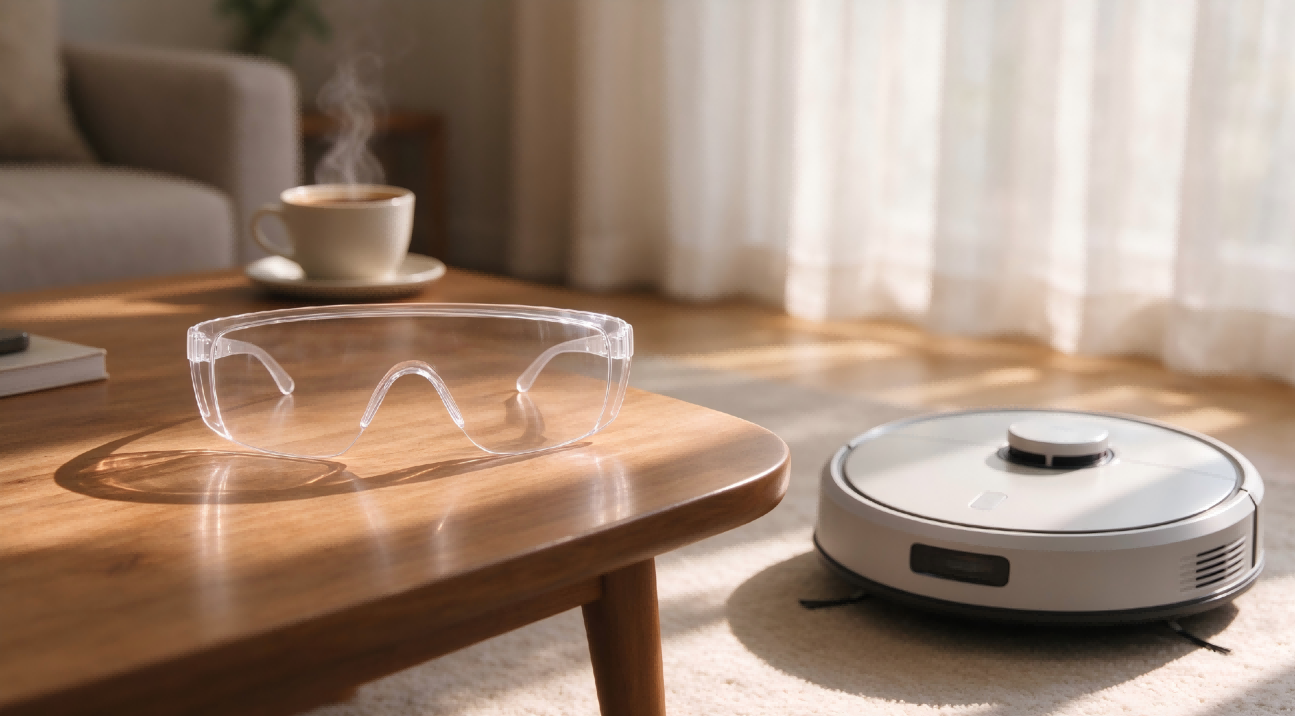
At some point, our homes began to get increasingly "smart." Robot vacuums navigate freely through living rooms, smart projectors cast giant screens in bedrooms, and children explore virtual worlds wearing VR headsets. While these devices have vastly improved our quality of life, the LiDAR systems or laser light sources commonly embedded within them invisibly emit infrared radiation that is imperceptible to the human eye.
Frequent exposure to infrared laser radiation can not only cause irreversible retinal damage to household members—particularly children and pets—but also trigger sensor interference between devices. Consequently, there is an urgent industry need for a "safety window" for these smart devices—one that blocks laser radiation without compromising light transmission.
II. A Material Breakthrough: PC/PMMA/PS Blends Enter the Consumer Market
Traditional glass protective materials are heavy and fragile, failing to meet the requirements for lightweight design and drop resistance in smart home devices. The market urgently requires a material that combines high transparency, exceptional impact resistance, and superior optical blocking capabilities.
Addressing this specific challenge, PC (polycarbonate) and its composite systems (PC/PMMA/PS) have opened up vast application possibilities. PC is renowned as "bulletproof plastic"; its impact strength is hundreds of times that of ordinary glass, offering robust physical protection for precision optical sensors. By blending in PMMA (acrylic) and PS (polystyrene), the material retains high visible light transmission—ensuring a sleek, transparent appearance—while precisely absorbing or reflecting infrared laser light at specific wavelengths.
This means that whether used for the LiDAR window of a home robot vacuum or the infrared camera lens of a smart lock, components made from these modified materials ensure precise device operation while completely eliminating the risk of laser-induced eye damage.
III. Current Industry Landscape and Future Trends
Upstream material suppliers are actively investing in R&D, striving to strike an optimal balance between high protection and high transparency while enhancing weather and aging resistance to withstand the complex and varied conditions of home environments. Meanwhile, downstream consumer electronics manufacturers are accelerating product certification processes to ensure their smart devices comply with international laser safety standards (such as IEC 60825).
It is foreseeable that with the increasing adoption of whole-home smart systems and autonomous driving, PC-based laser protection materials will evolve from specialized industrial components into silent guardians of safety in countless households. For material enterprises, the ability to bridge the gap between high performance and low-cost mass production will be the key to securing a pivotal position in the smart home supply chain.