

I. Basic Definition and Core Positioning
PC cold-resistant materials belong to the category of low-temperature toughening modified engineering plastics. By uniformly dispersing nano-scale high-efficiency toughening functional components within a PC resin matrix, the low-temperature fracture toughness of the material itself is improved.
It fills the performance gaps of ordinary PC materials under low-temperature conditions, while inheriting the excellent structural properties and processing adaptability of the PC substrate. It can directly replace ordinary PC, cold-resistant ABS, low-temperature glass, and other materials, making it suitable for extreme environments with multiple requirements for low-temperature impact resistance, structural strength, and operating temperature range.
II. Core Working Principle of Cold Resistance
Bulk Toughening Mechanism (Mainstream Long-Term Solution in the Market)
Highly efficient toughening particles are uniformly distributed within the PC matrix, forming an energy absorption network. When the material is subjected to low-temperature impact, the toughening particles induce numerous crazes and shear bands, dispersing and absorbing impact energy while effectively preventing crack propagation, fundamentally avoiding brittle fracture at low temperatures. The level of protection is measured by the low-temperature notched impact strength.
- Mainstream products can maintain more than 80% of the impact strength at room temperature even at -40℃, without obvious embrittlement.
III. Product Categories (Classified by Cold Resistance Rating and Molding Process)
- Classified by Cold Resistance Rating
|
Category |
Minimum operating temperature |
Core Features |
Typical application scenarios |
|
Standard cold-resis-tant grade PC |
-20℃ |
Balancing toughness and rigidity, offering high cost-effectiveness. |
Winter outdoor equipment, cold chain packaging |
|
Deep cold-resistant PC |
-40℃ |
High toughness at extreme low temperatures, stable during thermal cycling |
Extreme cold region engineering, cryogenic equipment, high-altitude outdoor gear |
(2) Classification by Modification Process and Properties
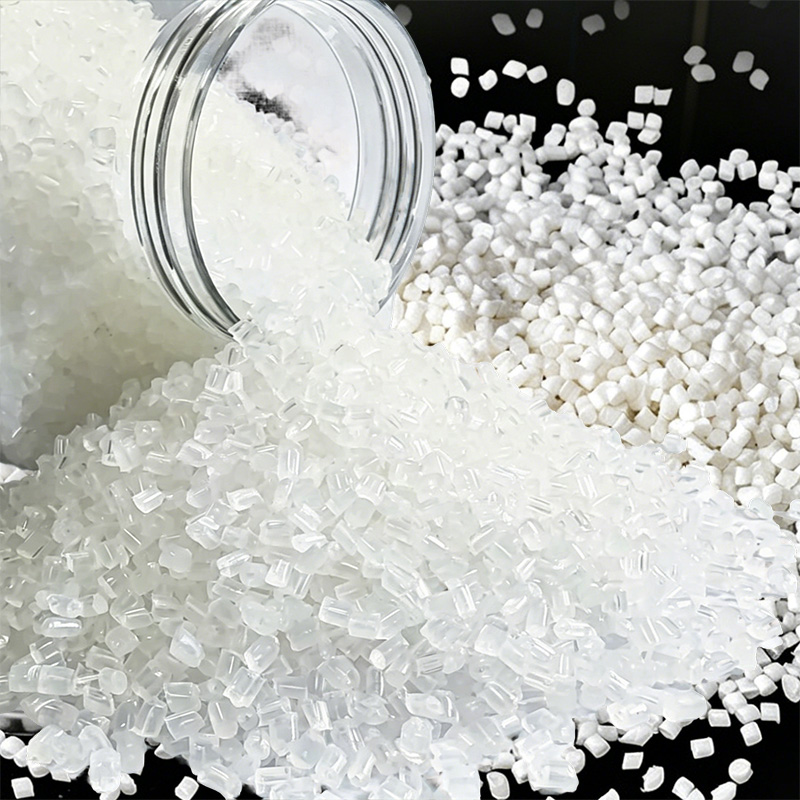
1. Bulk Blending Toughened Type (Preferred for Industrial Applications): Cold-resistant masterbatch and PC granules are fully blended and extruded in a twin-screw extruder. The toughening components are uniformly embedded within the substrate, resulting in stable performance and anti-aging properties without delamination. The granules can be directly injection molded or extruded, suitable for mass production of complex structural parts, and is the mainstream specification for industrial applications.
2. Transparent Cold-Resistant Type: Utilizes a special optical-grade toughening system, improving low-temperature toughness while maintaining high light transmittance. It features low haze and good optical uniformity, making it suitable for observation windows, protective masks, and other applications requiring visibility in low-temperature environments.
- Extruded Cold-Resistant PC Sheets: Produced as sheet products through extrusion, these sheets can be cut, bent, and thermoformed. Suitable for large-area low-temperature protective windows, equipment protective covers, cold storage partitions, and other applications.
IV. Key Physical, Chemical, and Safety Performance Advantages
1. Low-Temperature Mechanical Properties (Core Advantage)
Maintains excellent notched impact strength even at -40℃, far superior to ordinary PC and ordinary cold-resistant plastics; it does not experience brittle fracture at low temperatures and can withstand complex working conditions such as impact and vibration, providing reliable structural safety for equipment in extreme environments.
2. Comprehensive Mechanical and Insulation Properties
While improving low-temperature toughness, it fully retains the high rigidity, creep resistance, and dimensional stability of the PC substrate; it also possesses excellent electrical insulation properties, suitable for the insulation protection needs of high and low voltage electrical and electronic components.
3. Wide Temperature Range Weather Resistance
The material can be used stably for a long time within a wide temperature range of -40℃ to 120℃, exhibiting excellent thermal cycling performance without performance degradation due to frequent temperature changes; it also possesses good resistance to ultraviolet radiation and chemical corrosion, making it suitable for complex outdoor environments.
4. Excellent Processing Compatibility
Maintaining the excellent moldability of PC material, it supports various processes such as injection molding, extrusion, and blow molding, resulting in high molding precision and a smooth product appearance. It also allows for secondary processing such as cutting, drilling, hot bending, and bonding, providing flexible customization options.
5. Compliance and Safety Certifications
The product complies with RoHS and REACH environmental standards and is available in customized specifications such as food contact grade and flame retardant grade, meeting the compliance requirements of various industries including food cold chain, medical, and electronics, and is compatible with export equipment.
V. Main Application Scenarios
1. Cold Chain and Cryogenic Equipment (Core Application Area)
Widely used in cold chain logistics turnover boxes, pharmaceutical refrigerated box structural components, frozen storage shelves, internal components of refrigeration equipment, and accessories for cryogenic experimental equipment. It remains resistant to cracking under continuous low temperatures, ensuring the structural reliability of the equipment.
2. High-Altitude Outdoor Engineering and Equipment
Used in outdoor communication equipment housings, electrical insulation components, photovoltaic module accessories, and outdoor security equipment housings in extremely cold regions. It withstands extreme winter temperatures and diurnal temperature variations, extending the service life of outdoor equipment.
3. Automotive and Transportation Sector
Used in automotive exterior structural components, headlight functional components, low-temperature battery structural components for new energy vehicles, and vehicle electronic housings. It can adapt to temperature differences across regions, ensuring the reliability of vehicles in extremely cold areas.
4. Snow and Ice Sports and Protective Equipment
Used in snow and ice sports equipment accessories, outdoor low-temperature protective masks, and safety gear structural components. It maintains structural strength and impact resistance in low-temperature environments, improving the safety protection level of the equipment.
5. Special and Scientific Equipment
Applications include viewing windows for cryogenic experimental equipment, accessories for polar scientific research equipment, and special protective structural components, meeting the special usage requirements in extreme low-temperature environments.
VI. Comparison with traditional low-temperature materials
|
Comparison Dimensions |
PC cold-resistant material |
Standard PC |
Cold-resistant ABS |
Low temperature glass |
|
Low temperature impact resistance |
Excellent performance, maintaining high toughness even at -40℃. |
Poor, it becomes brittle rapidly below 0°C. |
Generally, toughness decreases signifi -cantly at -20℃. |
Poor quality, extremely fragile at low tempera -tures. |
|
Structural rigidity |
high |
high |
medium |
High but brittle |
|
Transparency |
Customizable high transparency |
High transpa -rency |
Most are opaque; transpa -rent versions have poor perfor -mance. |
High transpa -rency |
|
Applicable temperature range |
-40℃~120℃, wide temperature range |
-10℃~120℃, low temperature restrictions apply. |
-30℃~80℃, prone to deforma -tion at high tempera -tures. |
Wide temperature range but fragile |
|
Process -ability |
Excellent performance, supports multiple processes and secondary processing. |
Excellent |
good |
Poor quality, only suitable for cutting. |
|
Overall service life |
Long-lasting, weather-resistant and aging-resistant |
Medium and low temperatures can easily cause failure. |
Generally, long-term use can easily lead to aging. |
Long but easily damaged, high maintenance costs |
VII. Key Technology Considerations for Material Selection
1. Low-Temperature Rating Matching: PC cold-resistant materials must be selected according to the lowest ambient temperature of the application scenario. Temperatures exceeding the rated range will lead to rapid performance degradation and pose structural safety hazards.
2. Performance Balance Matching: For scenarios with additional requirements for transparency, flame retardancy, and rigidity, corresponding modification systems must be selected to avoid the loss of other key performance characteristics due to single toughening methods.
3. Structural Design Adaptation: For low-temperature load-bearing structural components, it is recommended to optimize the rounded corner design to avoid stress concentration. Appropriately increasing wall thickness redundancy can further improve impact resistance reliability under low-temperature conditions.
4. Prohibited Use Scenarios: Long-term use above the material's upper limit temperature is prohibited. When extreme ultra-low temperatures exceed the rated range, low-temperature performance verification must be conducted in advance to avoid the risk of brittle fracture.
VIII. Industry Technology Evolution Direction
1. Ultra-Low Temperature Modification Upgrade: Breakthroughs in toughening technologies for temperatures as low as -60℃ and even lower will expand the application boundaries of extreme environments such as polar scientific research and deep-space equipment.
2. Multifunctional Composite Modification: Building upon cold-resistance, it integrates multiple functions such as flame retardancy, antistatic properties, and UV resistance, adapting to the composite performance requirements of high-end fields such as new energy and semiconductors.
3. Optimized Transparent Cold-Resistant System: Further enhancing the optical properties and low-temperature toughness of highly transparent cold-resistant PC, gradually replacing glass windows in low-temperature environments, achieving lightweighting and high safety.
4. Low-Carbon and Environmentally Friendly Formula: Developing a bio-based cold-resistant toughening system reduces the carbon footprint of material production and use, aligning with global environmental protection and sustainable development trends.
IX. Conclusion
With its high toughness at extreme low temperatures, excellent comprehensive mechanical properties, wide temperature range applicability, and good processing adaptability, cold-resistant PC materials effectively compensate for the shortcomings of ordinary PC's low-temperature embrittlement and the narrow temperature range and insufficient strength of traditional cold-resistant materials, becoming a high-performance structural material that combines reliability and economy in extreme low-temperature environments.
With the expansion of the cold chain logistics industry, the development of new energy and outdoor engineering in high-altitude and cold regions, and the rapid development of the ice and snow equipment industry, wide-temperature-range, high-performance cold-resistant modified PC materials will gradually replace traditional low-temperature materials and become the mainstream engineering plastics choice for extreme working conditions.